The Embodiment of Time
A curatorial essay by Deborah Lim in response to the “The Unbearable Lightness” a solo exhibition by Sheena Liam
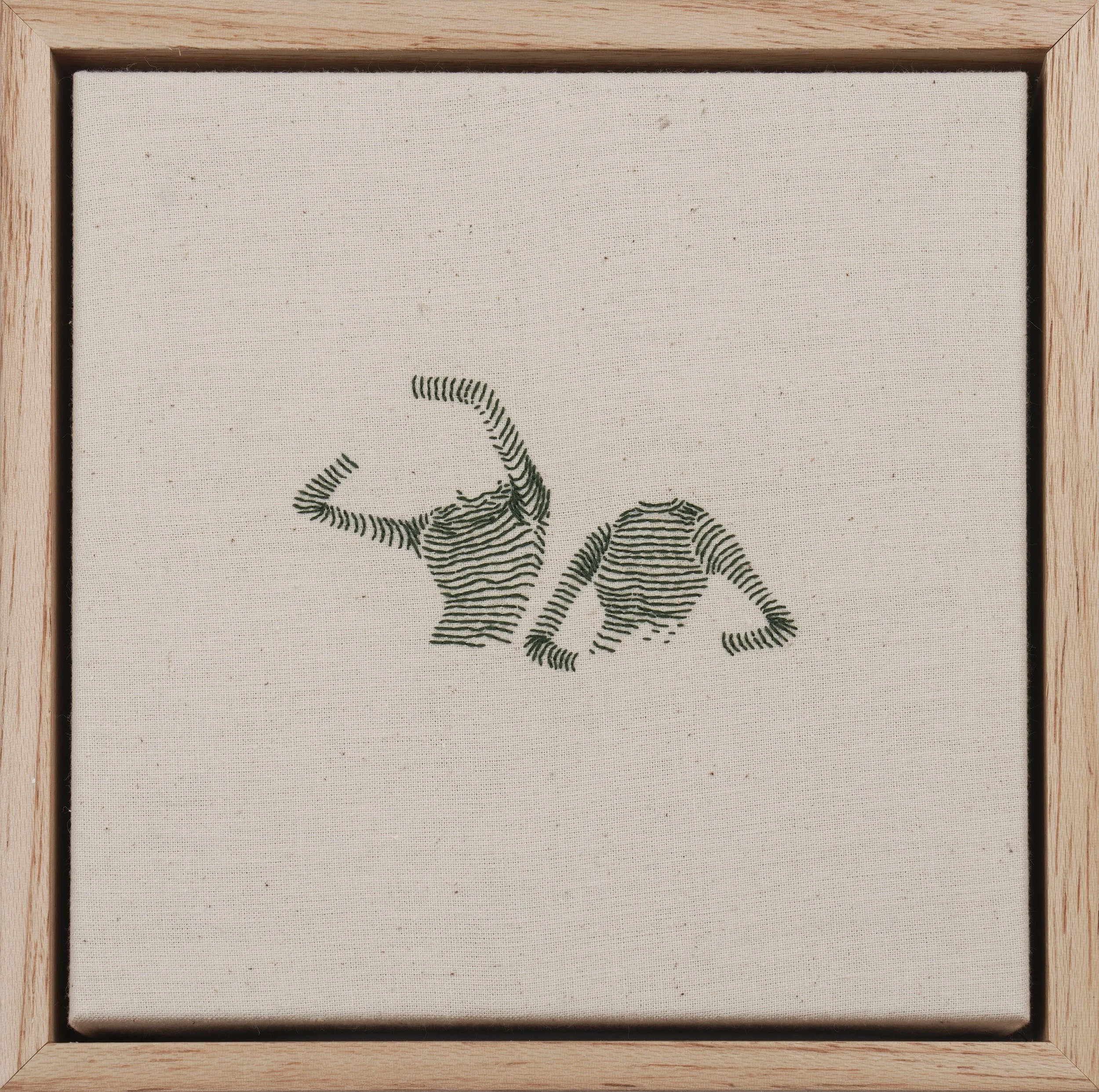
About ten years ago, after attending life drawing classes, Sheena Liam began embroidering female figures on raw canvas using deep green thread. These were visual journals that expressed more than words could say—responses to how she was feeling, to memories, encounters and lived experiences. Her challenge to herself was to continually increase the complexity and scale of each artwork while remaining grounded in the simplest foundation of embroidery: the single backstitch.
What began as an instinctive act of recording has, over time, evolved into an embodied practice. Each line carries the trace of the hand that made it; each figure is brought into being through the accumulation of hours of repeated gestures. Time is spent in the making of these works and, crucially, held within them.
The figures themselves seem to exist within another kind of time, suspended in movements that have neither fully begun nor ended. They are not quite still, nor are they completely in motion; instead, they inhabit the fleeting space between one state and the next.
Sheena’s understanding of the body is further shaped by her relationship with movement. Having danced ballet from a young age through her teens, she became intimately familiar with the discipline and countless hours required to achieve effortless technique. Her years of modelling led to an acute awareness of body language: how a simple gesture, a turn of the head or a directed gaze could alter an entire pose. These experiences converge in her figures, which often seem to have been caught not in a fixed pose, but in the act of moving into one.
Repetition is central to both dance and embroidery. A dancer repeats a movement until it becomes embodied; Sheena repeats a stitch until it forms an image. In both, a simple gesture accumulates into something more complex, with expression emerging through the process itself. What we encounter as a finished figure is also a record of the incalculable movements that brought it into being.
However, the time contained within these works does not necessarily mirror the time in which they are encountered. An artwork embroidered over hours or days can be absorbed in a matter of seconds: first as an image on a screen, then perhaps as a brief moment within the endless scroll of digital circulation. Sheena’s practice is rooted in slowness, repetition and the physical presence of the hand, yet images themselves travel far and wide. Works born of duration nevertheless enter a culture of acceleration. This process is a deliberate choice in the age of artificial intelligence.
Perhaps it is this tension that makes Sheena’s works linger in one’s mind. However quickly they may first be glanced at, they ask something different of the viewer in person. It is only through a slow and considered act of looking that the meticulous line work, expanse of negative space and individual stitches become truly visible. What might first appear minimal reveals itself as the residue of time: not merely the time of the artist’s labour, but the time required to observe, absorb and remain with the work.
“For it is in slowness and the capacity to parse one’s own present that one gains ground on what’s coming up next, perhaps restores to the every day some degree of agency, perhaps some degree of resistance.” [1]
—Pamela M. Lee, Chronophobia: On Time in the Art of the 1960s
In Sheena’s work, time is not simply a measure of labour, but a material and a condition of looking. The women she depicts seem suspended between movements, while the stitches that form them hold the accumulated gestures of the artist’s body. To spend time with these works is to enter a space between movement and stillness, acceleration and pause, where the present can be felt rather than simply passed through.
1. Pamela M. Lee, Chronophobia: On Time in the Art of the 1960s (Cambridge, MA and London: MIT Press, 2004), 308
Deborah Lim is an independent curator from Singapore who specialises in hybridities, bridging contemporary art with other disciplines.